Three Doors Problem
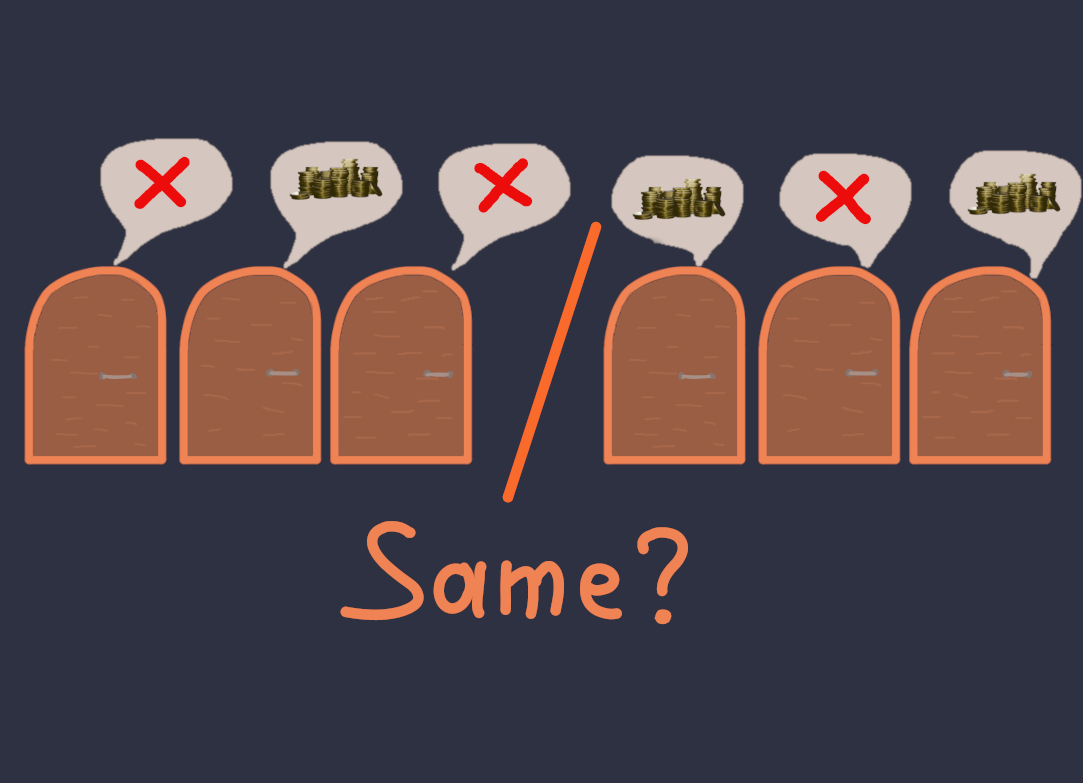
published at 17-07-2026You are standing in front of three unopened doors. Two doors hide nothing; one hides untold riches.
- You can choose any door.
- After you make your choice, the host reveals one of the empty doors. (but never your door)
- Now you're free to open either unopened door.
What strategy gives you the best chance of winning?

First intuition
There are three doors, and one is correct. The chance of winning is 1/3. Switching doors should not change anything. The maximum expected win rate is 33%.
Alternatively, we are left with 2 doors: one right, one wrong. The chances are 50% / 50%.
But that is not true. In fact, always switching doors doubles your chances from 33% to 66%! But why?
Calculating the real chances
Let's make the numbers bigger to get a better feel for it.
Instead of three doors, let’s imagine 100 doors, only one of which hides the prize.
Then the host opens 98 wrong doors. There are two closed doors left: yours and one other door.
Let's call the probability of winning with your door Pyour-door and the probability of winning with the last door Plast-door.
Now, with two doors left, the total probability that one of them is right is 100%.
We can express this as: 100/100 = Plast-door + Pyour-door
That means:
Plast-door = 100/100 - Pyour-door
Try it yourself
There are 15 doors, not 100, but this should still give us visible results.
Final interpretation
At first, you have a relatively low chance of choosing the right door. After the reveal, most of the wrong choices disappear. However, the revealing process does not affect your original choice or change what is behind your door. One of the two remaining doors has to contain the prize.
This means that revealing the wrong doors does not affect the probability associated with your door. Instead, it concentrates the probability of all the other doors in the last remaining door.
The trick lies in the set of doors available to the host. Only the remaining unchosen doors are available, and together they initially have a better chance of hiding the prize.

Your door does not participate in this probability redistribution because your choice removes it from the pool of doors that the host may open. If the host were allowed to open your door as well, the two doors left at the end would always have equal chances: 50% / 50%.
Breaking the game
Here, the host can open your door. The expected win rate is 50%, regardless of your strategy.
Here, the host cannot open your door. The expected win rate is 80% with an always-switch strategy.
Afterword
So, with three doors, it works just as we discovered: switching gives us a 2/3 chance of winning. To see it in action, I built this ugly little site to collect precise statistics on different strategies. You can visit it here.
P.S. To be fair, I hadn't done the math when I built the site. The site was my way of proving to myself that it really works this way.